
Storms
How to Photograph Lightning in Las Vegas
What I have learned from four monsoon nights, 46 keepers and a lot of empty frames.
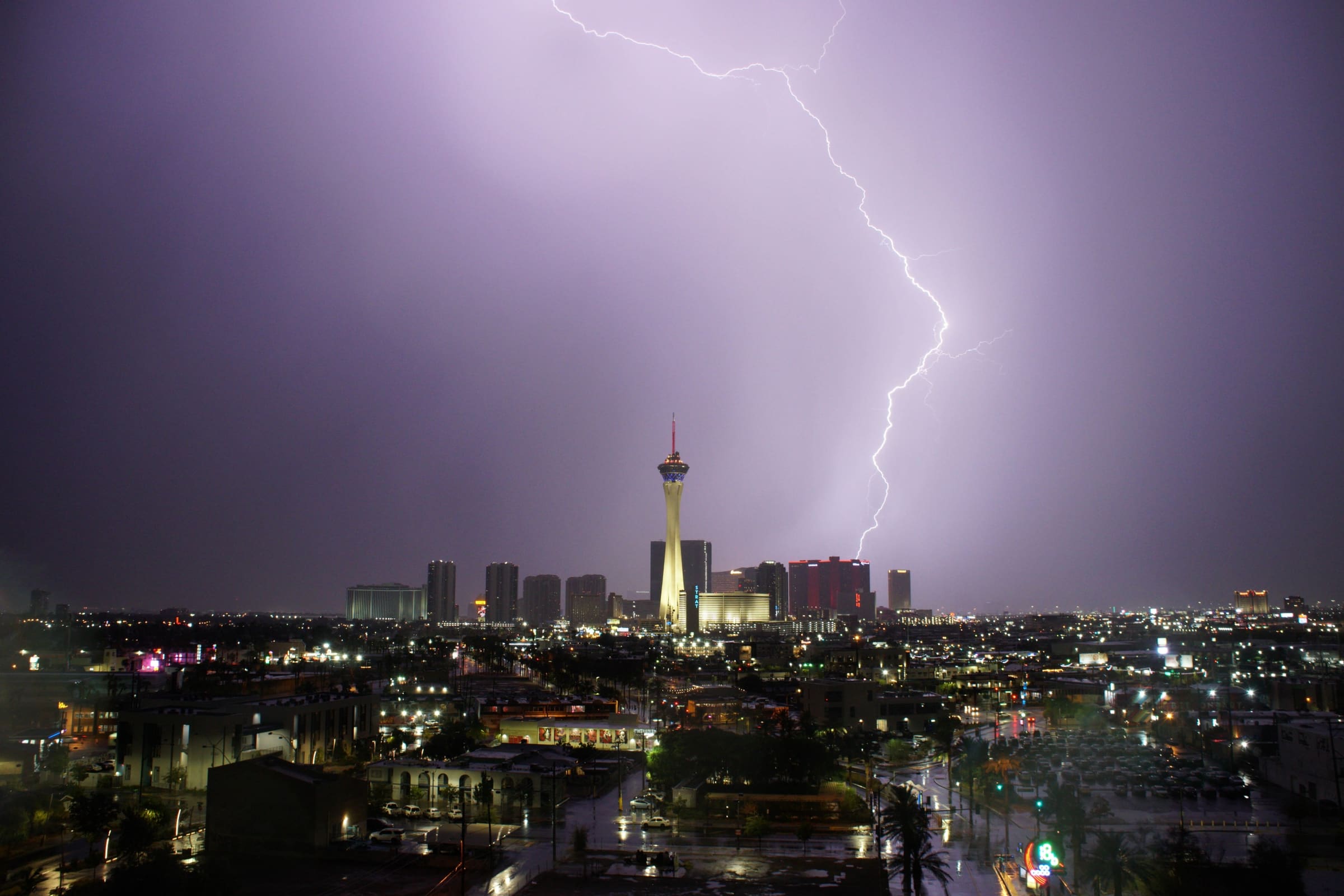
Forked Strike Beside the Strat
The short version
Put the camera on a tripod, frame the skyline at the wide end of your zoom, focus manually, set the exposure by hand and hold the shutter down in continuous mode while the storm is still several miles away. Most of my keepers were 1/15 of a second at f/5.6 and ISO 1000 on a Sony a6500. Watch from shelter, not an open rooftop.
When to go: monsoon season
The North American monsoon officially runs from June 15 to September 30 in southern Nevada, but the storms that actually light up the valley usually show up in July and August. Nearly every lightning photo in my Mother Nature collection came from four nights in July 2021, July 2022 and August 2022.
The best storms for photos are the ones you can see from a distance: a cell sitting over the edge of the valley or moving across it, with clear air between you and the rain. Once the rain is on top of you, the view is gone and so is the safety margin.
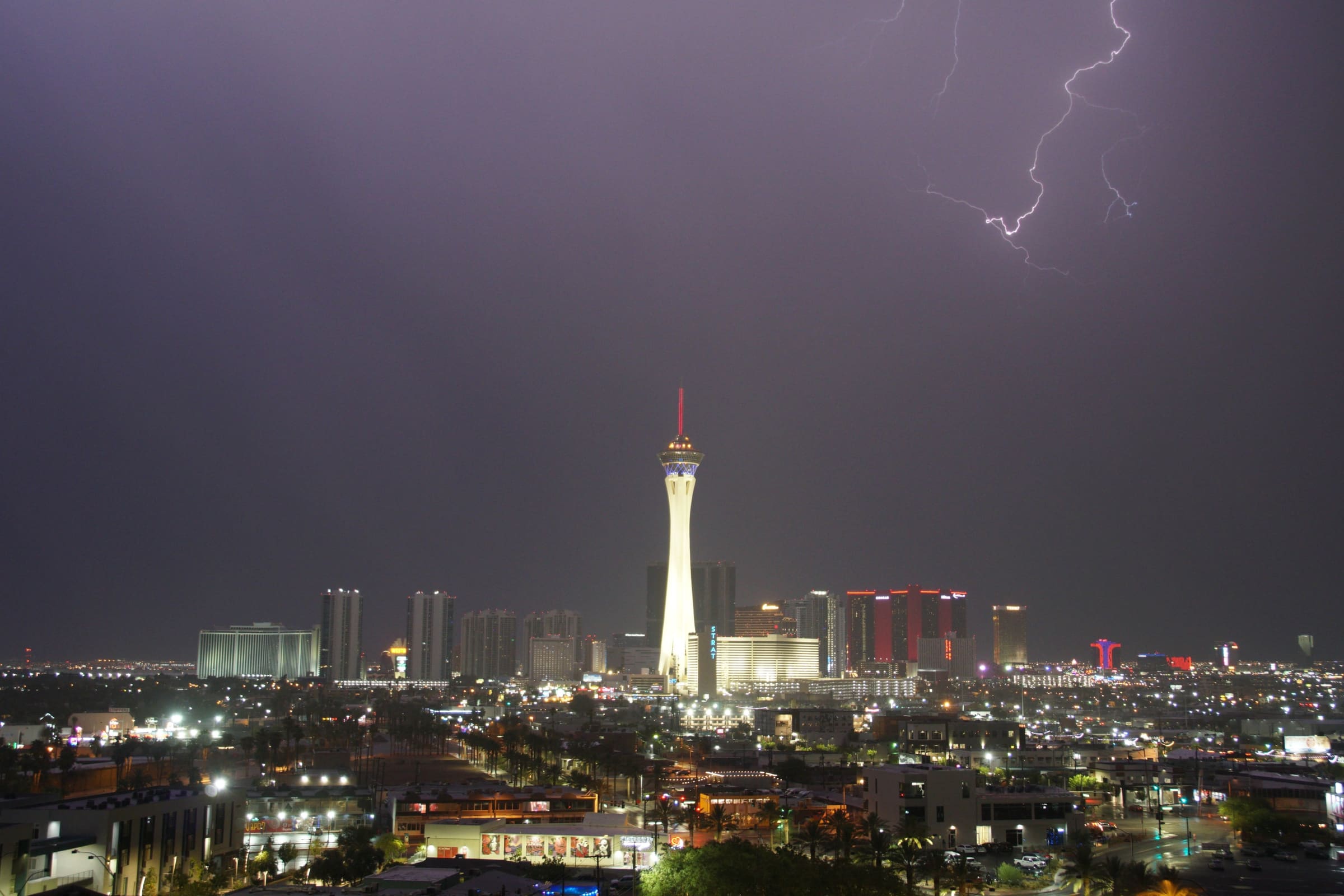
Lightning Over the Strat
Lightning over the Strat with the Strip hotels lit up behind it. I had been waiting for a bolt to land in the same frame as the tower, and this forked one showed up in the top right corner. 26mm, 1/10s at f/4. See it in the collection
Settings that work in the city
A lot of lightning guides tell you to use long exposures of 10 to 30 seconds and let the bolt draw itself. That works in a dark desert. In the middle of Las Vegas the sky is bright, the Strip is brighter, and a 20-second exposure turns into a white smear.
So I go the other way. My most common settings were 1/15 of a second, f/5.6 and ISO 1000, somewhere between 18mm and 25mm. I hold the shutter down in continuous mode and let the camera fire frame after frame. A single lightning flash usually flickers through several strokes over a few tenths of a second, so at 1/15 a burst of frames has a real chance of catching one of them. The rest of the frames are empty sky, and that's fine.
- Shutter: 1/15 s is my default in the city. My range has been 1/20 s to 1/2 s; the half-second frames caught crawlers spreading through the cloud base.
- Aperture: f/4 to f/5.6. Wide enough to keep the ISO sensible, stopped down enough that a close bolt does not blow out the whole sky.
- ISO: 640 to 1250, set so the city lights look right before any lightning shows up.
- Focus: manual, set on the lights of the skyline. Autofocus hunts in the dark and misses the moment.
- Drive: continuous high. Shoot in bursts of a few seconds so the buffer can clear.
- Lens: the wide end of the zoom. You can't predict where the next strike lands, and you can always crop.
Composition: give the bolt something to stand next to
Lightning over empty desert is impressive in person and a little anonymous in a photo. A landmark gives it scale and tells people where it happened. The Strat is my go-to because it is visible from almost everywhere in the valley. Downtown and the World Market Center buildings show up in my frames from several storms for the same reason.
Frame the landmark low or off to one side and leave most of the frame for sky. Then don't touch the composition. The bolt that lands right beside the tower usually shows up a minute after you give up and recompose.
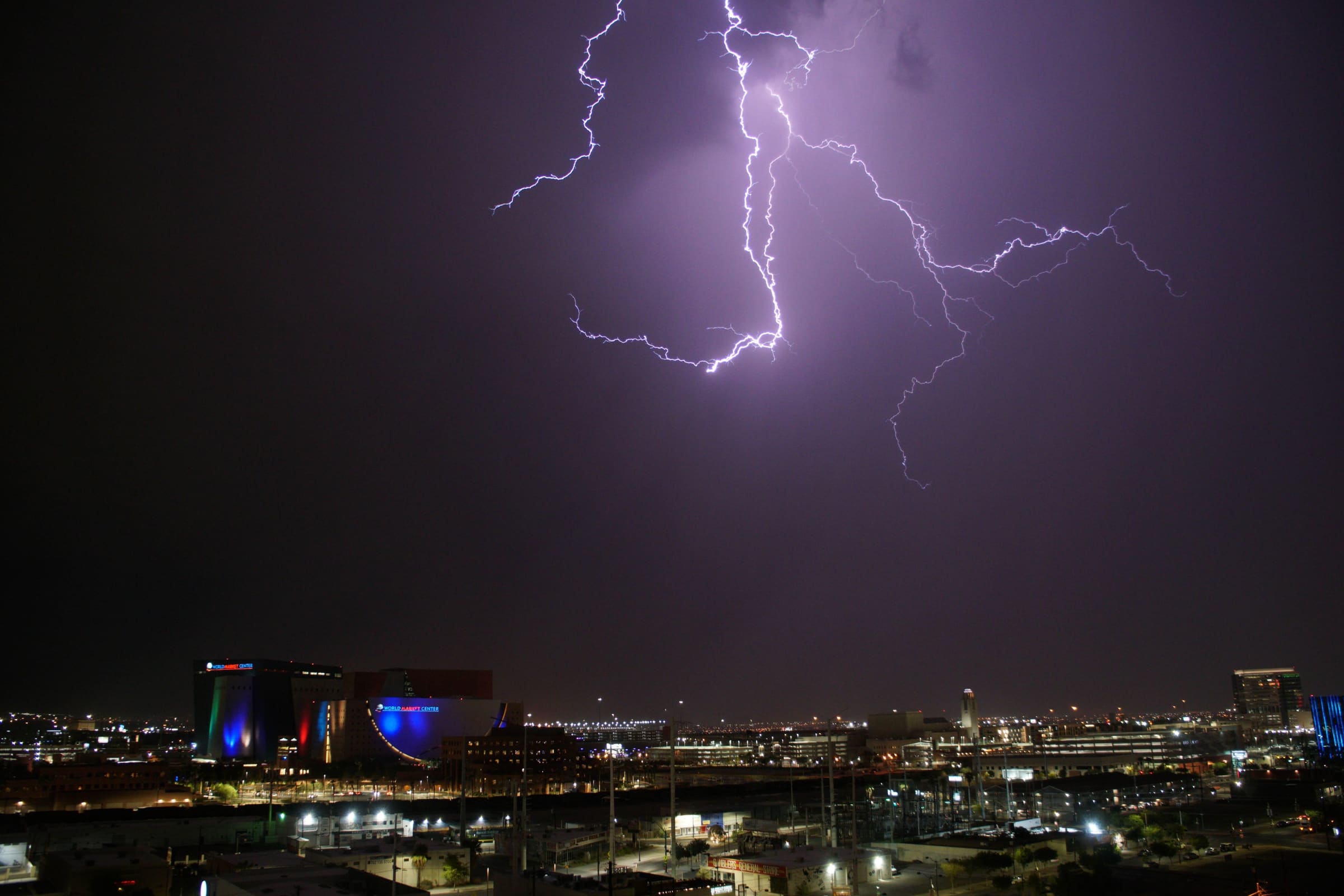
Lightning Tree Over Downtown Las Vegas
My favorite kind of strike, the ones that branch out sideways across the sky instead of just dropping straight down. This one stayed under control at 1/15s, f/3.5 on the a6500, so the sky held its dark purple instead of blowing out to white. See it in the collection
Crawlers versus strikes
Not every good frame has a bolt hitting the ground. Crawlers, the branching lightning that spreads sideways through the bottom of the storm, light up the whole cloud and often look better than a straight strike. They also last a little longer, which is why my half-second frames caught them. If the storm is throwing crawlers, try slowing the shutter to 1/4 or 1/2 of a second and dropping the ISO to match.
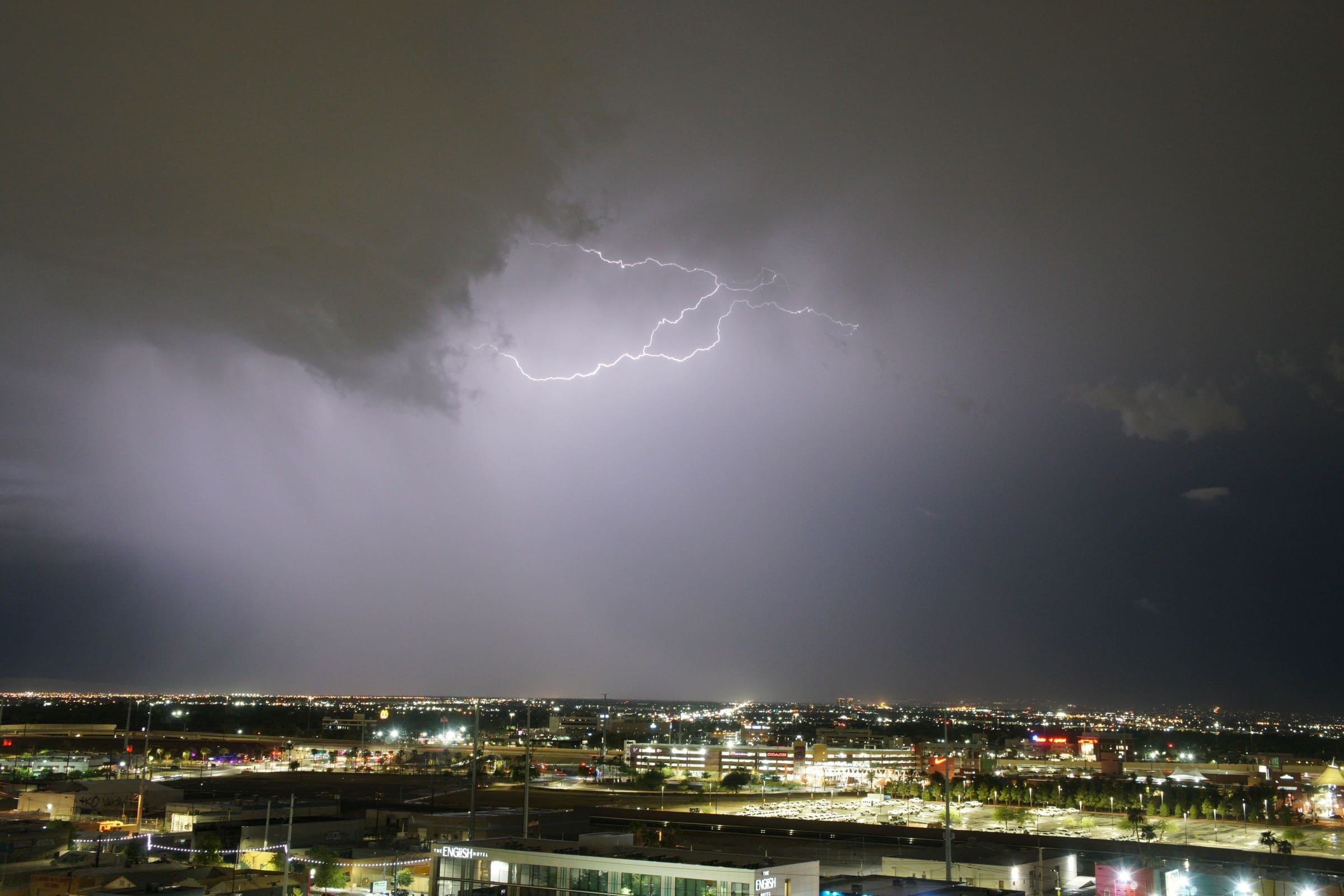
Crawler Lightning Over the Valley
This one never touched the ground. A crawler bolt spread sideways through the base of the storm and lit the whole sky purple over the city. Half-second exposure on the Sony a6500 at 26mm. See it in the collection
Stay safe while you do it
This part matters more than any setting. The National Weather Service's rule is simple: when thunder roars, go indoors. Lightning can strike miles away from the storm that produced it, so a storm that looks far off is not as far off as it looks.
- Shoot from inside a building or a hard-topped car, through a window or from a covered spot, not from an open roof, a hilltop or the middle of a parking lot.
- Pick storms that are moving across your view or away from you, and pack up if the gap between flash and thunder keeps shrinking.
- Las Vegas flash floods are real. Stay out of washes and never drive through a flooded road to reach a better spot.
If all you have is a phone
You can still get something. Lock the phone against a window frame or on a small tripod, turn the flash off, and record 4K video of the storm. Afterward, scrub through and pull out the frame with the bolt. It won't match a dedicated camera, but it beats waving a phone at the sky and hoping.
The settings behind these photos
| Photo | Focal length | Shutter | Aperture | ISO |
|---|---|---|---|---|
| Lightning Over the Strat | 26mm | 1/10s | f/4 | 800 |
| Lone Bolt and the World Market Center | 27mm | 1/8s | f/4 | 640 |
| Spider Lightning in Violet Sky | 23mm | 1/20s | f/4 | 800 |
| Lightning Tree Over Downtown Las Vegas | 18mm | 1/15s | f/3.5 | 1000 |
| Forked Strike Beside the Strat | 18mm | 1/15s | f/5.6 | 1000 |
| Crawler Lightning Over the Valley | 26mm | 1/2s | f/6.3 | 1250 |
| Storm Bolt Over the Strip Skyline | 30mm | 1/15s | f/4 | 1000 |
| Strike Behind Circa and Golden Nugget | 68mm | 1/15s | f/5.6 | 640 |
Questions people ask
What are good camera settings for lightning in a city?
Start at 1/15 second, f/5.6 and ISO 1000 with manual focus and continuous shooting, then adjust the ISO until the city lights look right. In dark places away from city lights, longer exposures of several seconds work better.
When is lightning season in Las Vegas?
Monsoon season officially runs June 15 to September 30. Most of the thunderstorms that produce lightning over the valley arrive in July and August.
Do I need a lightning trigger?
No. A trigger helps, but holding the shutter in continuous mode at a fast shutter speed works well, and it is how I made the photos in my Mother Nature collection.
Is it safe to photograph lightning?
Only from shelter. Shoot from inside a building or a hard-topped vehicle and go indoors when thunder is close. Lightning can strike miles from the storm itself.

