
Night sky
Milky Way Photography Near Las Vegas
A 30-second exposure, a kit lens and a dark patch of Nevada desert.
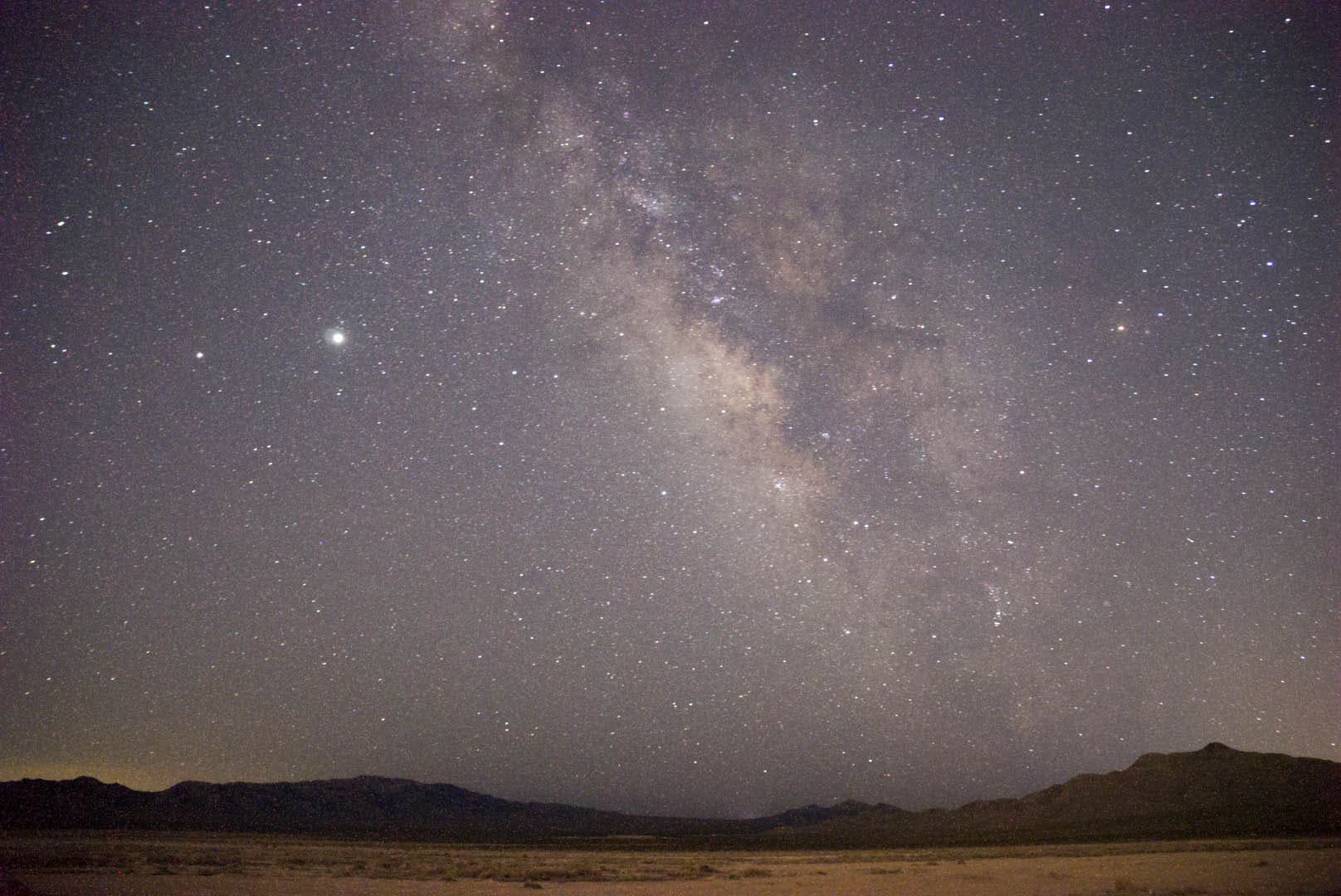
Milky Way Over the Desert Floor
The short version
Drive well away from the valley's light dome, go on a moonless night between spring and early fall, and put the camera on a tripod. My Milky Way shot was 30 seconds at f/3.5 and ISO 3200 with an 18mm kit zoom on a Sony a6500. On a crop sensor, keep exposures closer to 15 to 20 seconds at 18mm if you want pinpoint stars.
You have to leave the city
Las Vegas is one of the brightest places on Earth at night, and the glow reaches a long way into the desert. You won't see the Milky Way from anywhere in the valley in any meaningful way. Even in my photo, taken out in the Nevada desert, there is still a faint orange glow along the horizon that is probably distant city light.
The farther you drive, the better it gets. Death Valley National Park and Great Basin National Park are both certified International Dark Sky Parks, and both are within a long day's drive. Closer to town, anywhere that puts a mountain range between you and the city helps.
When to go
From southern Nevada, the bright core of the Milky Way rises in the south and southeast and is best placed from roughly spring through early fall, with summer the easiest. The moon matters as much as the season. Plan for a night near the new moon, or for the hours after the moon has set. My Milky Way and comet photos were both taken on the same night in July 2020.
Settings for a kit lens
You don't need a special lens to start. I used the 18mm end of a regular zoom at its widest aperture, f/3.5, for 30 seconds at ISO 3200. A faster lens (f/2.8 or wider) lets you shorten the exposure or lower the ISO, but a kit lens will get you the core.
- Exposure: the old "500 rule" says 500 divided by the full-frame-equivalent focal length gives the longest exposure before stars start to streak. At 18mm on an APS-C camera like the a6500 that is about 18 seconds. My 30-second frame is past that, and at full size the stars are slightly stretched.
- ISO: 3200 is a good starting point. Raise it if you shorten the exposure.
- Focus: manual. Magnify the screen on a bright star and turn the ring until it is as small as it gets, then leave it alone.
- Trigger: a two-second self-timer or a remote, so pressing the button does not shake the camera.
- Stabilization: turn it off when the camera is on a tripod.
Photographing a comet with a telephoto
In July 2020 Comet NEOWISE was bright enough to see without binoculars, and I pointed the long end of the zoom at it: 210mm, 10 seconds, f/6.3, ISO 4000, which was enough to show the dust tail. A thin streak crossed the frame during the exposure too, probably a satellite or a faint meteor.
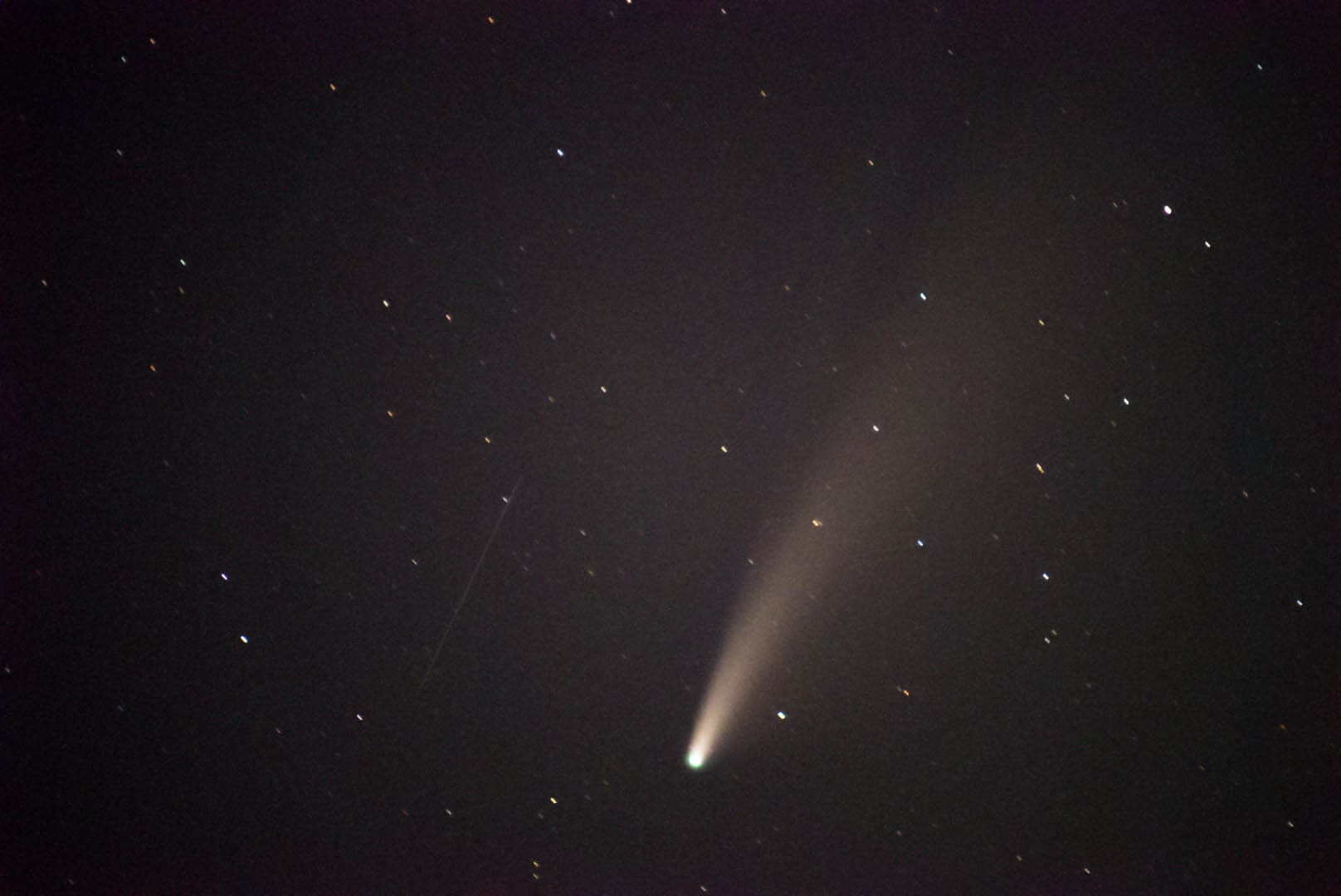
Comet NEOWISE and Its Dust Tail
Comet NEOWISE at 210mm on the a6500, a 10-second exposure at f/6.3 and ISO 4000. The thin streak on the left is something else crossing the frame during the exposure, probably a satellite or a faint meteor. See it in the collection
Ten seconds at 210mm on a fixed tripod will show some star movement if you look closely. A star tracker fixes that, but you can get a good comet frame without one. Try a few exposures between two and ten seconds and keep the sharpest.
Bring the boring stuff
Water, a headlamp with a red mode, warm layers even in summer, and a full tank of gas. The desert gets cold after midnight and there is often no cell signal where the sky is darkest. Tell someone where you are going.
The settings behind these photos
| Photo | Focal length | Shutter | Aperture | ISO |
|---|---|---|---|---|
| Milky Way Over the Desert Floor | 18mm | 30s | f/3.5 | 3200 |
| Comet NEOWISE and Its Dust Tail | 210mm | 10s | f/6.3 | 4000 |
Questions people ask
Can you see the Milky Way from Las Vegas?
Not from inside the valley in any meaningful way. The city glow washes it out. You need to drive well out into the desert, ideally with mountains between you and the city.
What settings should I use for the Milky Way with a kit lens?
Use the widest focal length and aperture, ISO 3200 and an exposure of about 15 to 20 seconds on a crop-sensor camera. A 30-second exposure works but shows slight star trailing at full size.
When is the Milky Way visible from Nevada?
The bright core is best placed from spring through early fall, with summer the easiest. Choose a night near the new moon.
Where are the darkest skies near Las Vegas?
Death Valley National Park and Great Basin National Park are both International Dark Sky Parks. Anywhere with a mountain range between you and the city is noticeably darker.

